
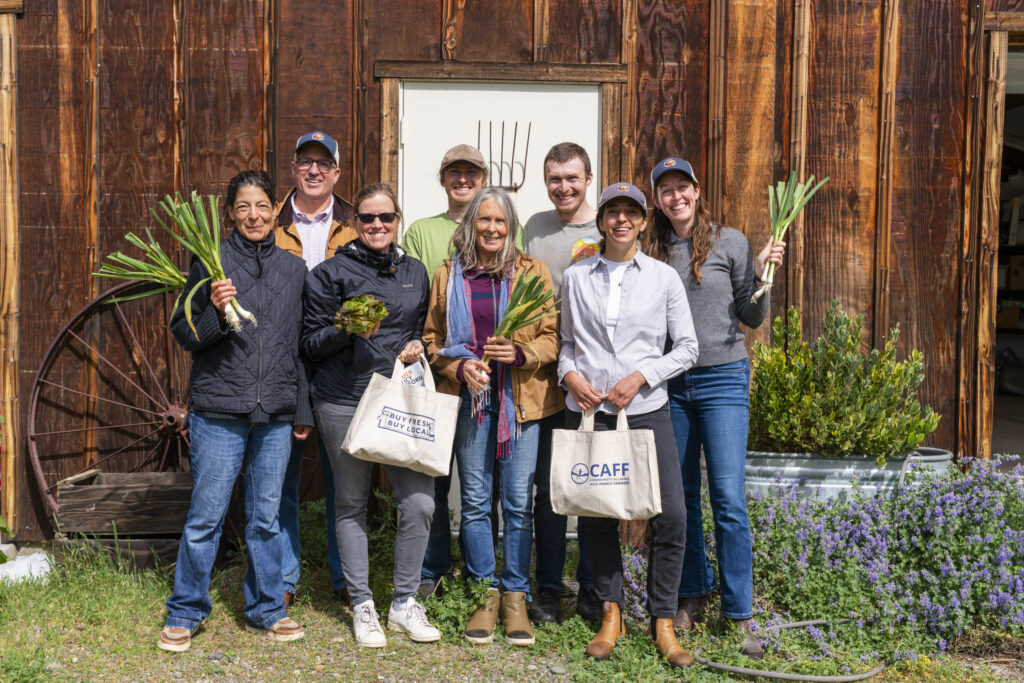
 For nearly 50 years, the Community Alliance with Family Farmers (CAFF) has focused on ensuring resilient food systems and supporting the farmers who help deliver them. Today, the need for strong advocacy is critical as new water regulations, climate pressures, and shifting policy needs create a challenging landscape to navigate for anyone, let alone the family farmers whose main goal is to put food on the table for millions of Californians.
When California passed the Sustainable Groundwater Management Act (SGMA) in 2014, it marked a turning point. For the first time in state history, groundwater — long treated as an unlimited private resource — would need to be managed sustainably. It was a necessary change after decades of overpumping and drought, but many feared the state was trying to take their water.
CAFF saw the bigger picture. The organization saw SGMA as an opportunity for collaboration, recognizing family farmers could be part of the solution if given the right tools and representation.
Nearly a decade later, the stakes are higher than ever. Across California, family farms are navigating razor thin profit margins and facing the threat of going out of business, not because they don’t believe in sustainability, but because they are being left behind by a complex and under-resourced system. “California has some of the safest, best produced food, but often regulations are being made with larger players in mind and that becomes really hard for smaller family farmers to comply,” says CAFF’s Deputy Director of Water Policy Catherine Van Dyke. “We need policies and regulatory spaces that understand high standards are important, but they need to be right sized for the businesses.”
In 2022, CAFF and its partners published a report on how small growers were underrepresented in groundwater sustainability planning. CAFF successfully advocated for state funding to help family farmers participate in local decision-making processes and continues to provide on-the-ground education so growers can understand their rights and responsibilities. Joined by the UC Agriculture and Natural Resources Small Farms Team and the UC Davis School of Law, CAFF is part of the Department of Water Resources (DWR) URCTA Program, providing technical assistance to farmers and helping state and local agencies understand the specific vulnerabilities to small farmers under SGMA.
But CAFF’s work doesn’t stop at groundwater. Working on legislative efforts such as AB 1466, AB 1413, and AB 524 and in coalition with partners across the state, CAFF continues to push for policy that reflects the realities of small farms. Instead of the massive farms that come to mind when people think about how their fruits and vegetables make it to the grocery store, CAFF is focused on those that sell directly to their communities and lack lobbyists or legal teams to help address compliance and consideration in the agricultural space.
This advocacy is more than a policy issue; it’s about protecting an ecosystem. “When family farmers are pushed out, we all feel it,” says Catherine. “The loss ripples through rural economies, local food access, pricing, and even the diversity of crops grown. When supply chains broke down at the beginning of the COVID-19 pandemic, it was local family farms that kept California fed. When the rubber hits the road, family farmers are essential services.”
CAFF is uniquely positioned to make sure policymakers don’t forget those lessons. Through its farmer-led policy committee, CAFF directly connects growers’ experiences to the halls of Sacramento, translating local realities into actionable policy. By combining technical assistance — like help with organic certification or grant applications — and policy advocacy, CAFF ensures sustainable agriculture works not just in theory, but in practice.
This work is strengthened by deep partnerships, including the one CAFF shares with the Water Foundation. “We really benefit from the Water Foundation’s broad perspective and water expertise,” says Catherine. “It can be hard to fundraise for this kind of policy work, and the Water Foundation’s unbiased, no-strings-attached support has made a huge difference and allows us to focus on what matters.”
In a time of climate uncertainty and rapid policy change, what matters is representation for the future. California needs organizations like CAFF that are policy focused, trusted, and deeply rooted to the farmers they serve, making sure those same family farmers have a seat at the table when decisions about their future are made.